


When comparing MMO titanium anodes, coating thickness and coating loading are two terms that often appear in technical specifications. They are related, but they describe different properties of the coating.
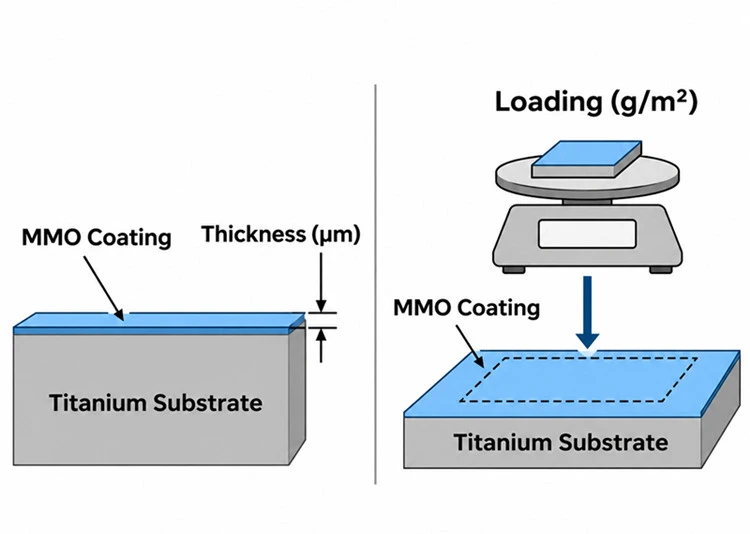
Coating thickness refers to how thick the oxide layer is on the titanium surface. Coating loading refers to the amount of coating material applied to a defined surface area.
A thicker coating does not always mean a higher coating loading. Likewise, two anodes with similar loading values may have different coating thicknesses.
Understanding this difference helps buyers read technical specifications more accurately and avoid confusion when comparing anode products.
1. What Is MMO Coating Thickness?
Coating thickness describes the physical distance between the titanium substrate surface and the outer surface of the coating.
It is normally expressed in micrometers (μm).
For MMO titanium anodes, the coating is formed through repeated application and thermal treatment. The finished layer is not always a perfectly smooth or solid film. Its surface structure can contain small cracks, pores, and variations in thickness.
This is one reason why thickness measurements need to be interpreted carefully.
1.1 What Does Thickness Tell Us?
Thickness provides information about the physical build-up of the coating.
It can help with:
- Checking the coating structure.
- Comparing coating distribution across different areas.
- Identifying unusually thin or uneven sections.
- Evaluating the coating structure on a cross-section.
For example, a coating may look uniform from the outside, but a cross-sectional examination may show differences between the edge and central areas.
1.2 How Is Coating Thickness Measured?
Cross-sectional microscopy is one method used to examine MMO coating thickness.
A small sample is prepared and examined under an optical microscope or scanning electron microscope (SEM). The distance between the substrate and the coating surface can then be observed at selected locations.
The measured value may vary depending on the sampling position and surface structure.
For this reason, a thickness result should ideally include the measurement method and sampling locations.
2. What Is MMO Coating Loading?
Coating loading describes the amount of coating material present per unit of coated surface area.
It is commonly expressed in:
- g/m²
- mg/cm²
In MMO anode specifications, loading often refers to the precious metal content, expressed as a mass per unit area. However, some specifications may refer to the total oxide coating mass.
These are not necessarily the same measurement.
For example, a Ru-Ir coating contains several oxide components. The total oxide mass includes both active precious metal oxides and supporting oxide components.
If a supplier specifies a precious metal loading, the value should not automatically be interpreted as the total weight of the finished oxide coating.
2.1 Why Is Coating Loading Important?
Loading helps describe how much coating material has been applied to the titanium substrate.
It is particularly relevant when comparing coating specifications, estimating precious metal consumption, and discussing manufacturing requirements.
For buyers, it can also provide a useful reference when comparing quotations for anodes with similar dimensions and coating systems.
However, loading alone does not determine the service life of an anode. Coating composition, manufacturing quality, current density, electrolyte conditions, and operating temperature also matter.
2.2 How Is Coating Loading Evaluated?
One common approach is to compare the sample weight before and after the coating process.
This can provide an indication of the coating mass added during production.
However, the weight difference represents the overall mass change. It does not automatically identify the amount of each precious metal oxide.
Where a specific Ru or Ir loading is required, an agreed chemical analysis method may be needed.
The measurement basis and sample area should be clearly defined before testing.
3. Why Are Coating Thickness and Loading Not the Same?
The relationship between thickness and loading depends on several properties of the coating.
Even when the coating is applied to the same titanium substrate, different formulations and manufacturing conditions can produce different results.
3.1 Coating Composition
Different metal oxides have different densities and chemical compositions.
For example, RuO₂, IrO₂, TiO₂, and Ta₂O₅ do not have the same material properties.
Changing their proportions changes the composition and mass of the finished coating.
Therefore, the same coating thickness does not necessarily represent the same coating loading when different formulations are used.
3.2 Porosity and Surface Structure
MMO coatings are not always completely dense.
Their internal structure may contain pores and fine cracks formed during the coating and thermal treatment process.
A coating with more internal voids may occupy a greater physical thickness without containing proportionally more solid coating material.
This is another reason why thickness cannot be directly converted into loading using one fixed value.
3.3 Coating Application and Thermal Treatment
MMO coatings are usually built through multiple application and heating cycles.
The number of coating cycles, application uniformity, and thermal treatment conditions all influence the finished layer.
Two production batches may have similar coating loading but show differences in their cross-sectional structure.
For this reason, coating quality should not be judged by thickness or loading alone.
3.4 Substrate Geometry and Coated Area
The shape of the titanium substrate also matters.
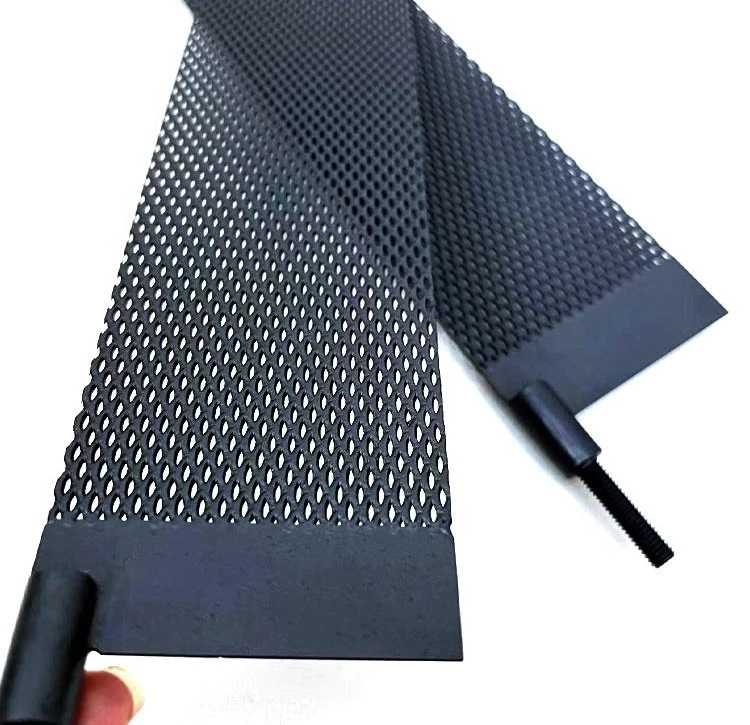
A flat titanium plate, expanded titanium mesh, and tubular titanium anode have different surface geometries.
For mesh anodes in particular, the actual coated surface area may differ considerably from the projected area of the finished product.
When loading is specified in g/m², the area used for calculation should therefore be clearly defined.
4. Comparison: Thickness vs Loading
The following table summarizes the main differences.
| Item | Coating Thickness | Coating Loading |
|---|---|---|
| What it describes | Physical coating thickness | Coating mass per unit area |
| Common unit | μm | g/m² |
| Main focus | Layer structure | Material quantity |
| Typical evaluation | Cross-sectional microscopy | Weight difference or chemical analysis |
| Influencing factors | Structure, porosity, uniformity | Composition, material quantity, area basis |
Neither measurement can fully replace the other.
Thickness helps describe the physical coating structure, while loading provides information about the amount of coating material present.
Some technical specifications include both values. When this happens, they should be treated as separate requirements.
5. What Should Buyers Check Before Ordering MMO Titanium Anodes?
When requesting an MMO titanium anode, it is useful to clarify the coating requirements before production.
A few points are worth checking.
Coating composition
Confirm whether the required coating is Ru-Ir, Ir-Ta, or another mixed metal oxide system.
Coating loading
If loading is specified, confirm whether the value refers to total oxide mass or precious metal content.
Coated surface area
For plates, meshes, and tubular anodes, make sure the calculation area is clearly defined.
Thickness requirements
If coating thickness is an acceptance requirement, specify the measurement method and sampling arrangement.
Application conditions
Provide the electrolyte composition, operating temperature, current density, and other available operating information.
These details help the supplier understand the actual requirements and prepare a more suitable coating specification.
6. Customized MMO Titanium Anodes from ZXB
Different electrolysis projects may require different coating systems, loading levels, and titanium substrate structures.
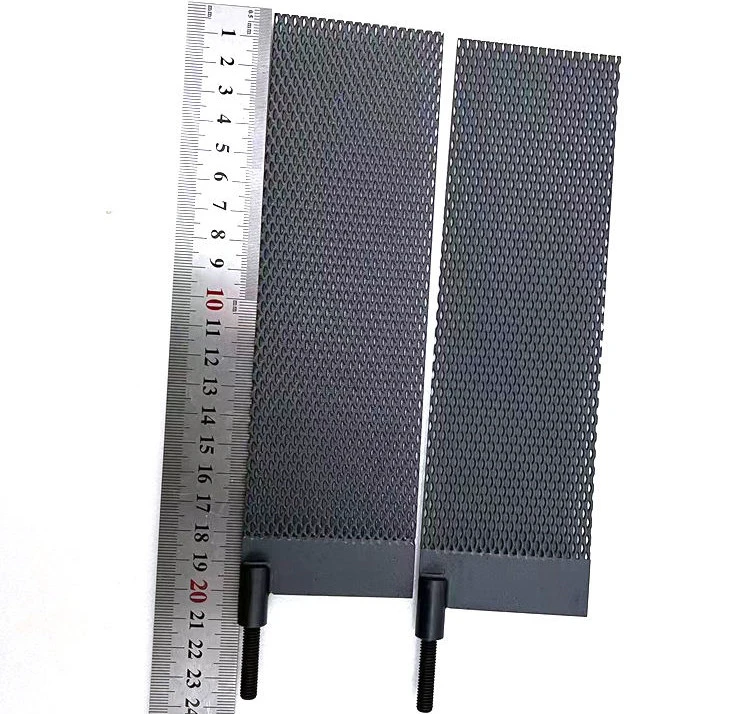
ZXB supplies customized MMO titanium anodes based on customer drawings and application requirements.
Available options include:
Ru-Ir and Ir-Ta coating systems, subject to application evaluation.
Titanium plate, expanded mesh, and tubular substrates.
Customized dimensions and active surface areas.
Different connection structures and mounting designs.
Agreed coating specifications and inspection arrangements.
For new projects, customers can provide technical drawings, existing electrode samples, or basic operating information.
ZXB can review the substrate dimensions, coating requirements, and working conditions before confirming the production details.
The aim is to provide an anode that matches the customer's equipment and actual application, rather than selecting a coating specification based on thickness or loading alone.
Frequently Asked Questions
Q1: Is Coating Thickness The Same As Coating Loading?
A: No. Thickness measures the physical dimension of the coating, while loading measures the amount of coating material per unit area.
Q2: Can Coating Loading Be Converted Directly Into Thickness?
A: Not reliably. The conversion depends on coating composition, density, porosity, and the definition of the loading value.
Q3: Does A Higher Coating Loading Always Mean A Thicker Coating?
A: Not necessarily. Different oxide compositions and coating structures can produce different thicknesses at similar loading levels.
Q4: Is MMO Coating Loading Based On Total Oxide Weight Or Precious Metal Weight?
A: It depends on the specification. Some suppliers use precious metal content as the loading basis, while others may specify total oxide coating mass. This should be confirmed before ordering.
Q5: How Is MMO Coating Thickness Usually Checked?
A: Cross-sectional microscopy, including SEM examination, can be used to observe and measure the coating layer at selected locations.
Q6: Which Is More Important For MMO Titanium Anodes, Thickness Or Loading?
A: Neither should be considered independently. The appropriate specification depends on the coating system, application, and inspection requirements.
Q7: What Information Should I Provide When Requesting A Customized MMO Anode?
A: The anode dimensions, substrate form, coating type, operating environment, and any specified loading or thickness requirements are useful starting points. Drawings and existing samples are also helpful.
Contact Us
Looking for customized MMO titanium anodes for electrolysis, water treatment, or cathodic protection?
ZXB can support different titanium substrate structures, coating options, and manufacturing requirements based on your project.
Email: jack@zxb-titanium.com
Send your drawings, technical specifications, or existing electrode samples to discuss your requirements.