


Titanium Anode for Sodium Hypochlorite Production
Your Professional Titanium Anode for Sodium Hypochlorite Production Manufacturer!
Founded in 2010, Baoji Zhongxinbao Metal Materials Co., Ltd. is a professional manufacturer and exporter of titanium products, located in Baoji, China's "Titanium Valley." We specialize in titanium bars, plates, tubes, and MMO anodes. With an in-house production facility and rich export experience, our products meet ASTM, ASME standards and are exported to over 30 countries worldwide.


Why Choose Us
Rich Experience
With over 15 years of titanium manufacturing experience in Baoji, we supply a full range of industrial-grade titanium materials tailored to demanding environments.
Advanced Equipment
Our facility is equipped with over 30 key production and testing machines, ensuring consistent product performance and long-term durability.
Professional Team
Our team collaborates regularly with clients in the aerospace, medical, and chemical industries to meet exacting tolerances, specialized alloy requirements, and accelerated lead time expectations.
Custom Service
We specialize in delivering customized titanium alloy solutions tailored to the needs of demanding industries, and we support OEM/ODM production based on technical drawings.
Product Parameter
|
Parameter |
Typical Value |
Notes |
|
Substrate Material |
Grade 1 Titanium |
ASTM B265 pickled finish |
|
Coating Type |
IrO₂–Ta₂O₅ MMO |
Sintered, 3-layer system |
|
Operating Current Range |
400–800 A/m² |
Peak: 1000 A/m² ≤30 min/session |
|
Voltage Stability |
2.0–2.3 V |
At 800 A/m², <±2% drift |
|
Chlorine Efficiency |
≥92% |
Verified with brine recirculation |
|
Coating Thickness |
5–8 μm |
SEM verified |
|
Estimated Lifetime |
~3.5 years @ 400 A/m² |
Lab-tested 6 years under controlled temp & salt |
Advantages of Titanium Anode for Sodium Hypochlorite Production

Corrosion Resistance: The sodium hypochlorite production process generates large amounts of chlorine gas and high-concentration chlorides, which are extremely corrosive. Therefore, the anode material must possess exceptional corrosion resistance to prevent damage. Titanium as an anode substrate offers excellent corrosion resistance and can work stably in chloride solutions for extended periods.
Good Conductivity: The electrical conductivity of anode material directly affects electrolysis efficiency. Titanium anodes have high conductivity, which can reduce power loss and lower energy consumption.
High Catalytic Activity: The surface of titanium anodes for sodium hypochlorite generators typically uses ruthenium-iron metal coatings to enhance chlorine evolution capability and improve electrolysis reaction efficiency.
High Temperature Resistance: The electrolysis process generates heat. Titanium anodes have excellent high-temperature resistance, effectively preventing deformation and degradation at elevated temperatures.
Long Service Life: Sodium hypochlorite production is a continuous process. Titanium anodes have a long service life, avoiding frequent replacement or maintenance, thereby reducing production costs.
Applications of Titanium Anode for Sodium Hypochlorite Production
Municipal Water Treatment
Ensuring safe drinking water by disinfecting and purifying municipal water supplies.
Swimming Pools and Spas
Maintaining clean and safe water by generating sodium hypochlorite on-site.
Cooling Towers
Preventing the growth of harmful microorganisms and algae in cooling water systems.
Industrial Water Treatment
Used in various industries, such as food and beverage, pharmaceuticals, and textiles, to produce disinfectant solutions for sanitation and process water treatment.
How to Produce Sodium Hypochlorite by Titanium Anodes


Basic Principle
The production of sodium hypochlorite by electrolysis is based on the electrolysis of a sodium chloride solution (typically 3%–5%). During the process, chlorine gas is generated at the anode, and it reacts with hydroxide ions (OH⁻) produced at the cathode to form sodium hypochlorite (NaClO). The overall process involves the oxidation of chloride ions (Cl⁻) at the anode and the reduction of water at the cathode.
Anode Reaction
At the ruthenium-iridium coated titanium anode, chloride ions undergooxidation.
2C1-→ Cl₂ + 2e-
The generated chlorine gas reacts with water to form hypochlorous acid (HCIOand hydrochloric acid (HCl):
Cl2+H2O→ HCIO +HCI
Hypochlorous acid further reacts with hydroxide ions to form sodiumhypochlorite:
HCIO + OH-→ CIO-+ H2O
Cathode Reaction
At the cathode, water undergoes reduction:
2H2О+2e-→H2+2OH-
The generated hydroxide ions react with the chlorine gas produced at theanode to form sodium hypochlorite.
Operating Conditions
Electrolyte concentration: 3%–5% sodium chloride solution.
Current density: 500 A/m²(calcuate as anode reaction area)
Temperature: Typically conducted at room temperature, but higher temperatures can increase reaction rates.
PH value: The electrolyte should be maintained at a neutral or slightly alkaline pH to ensure the formation of sodium hypochlorite.
Product Collection
The sodium hypochlorite solution produced during electrolysis can be directly collected from the electrolyzer. The concentration of the sodium hypochlorite solution can be controlled by adjusting the electrolysis time, current density, and electrolyte concentration.
Precautions
Coating protection: Ensure the integrity of the ruthenium–iridium coating to prevent peeling or damage,must avoid sharp objects scratch the anode surface.
Electrolyte purity: Use high-purity sodium chloride solution to avoid impurities that may affect electrolysis efficiency and product quality.
Equipment maintenance: Regularly inspect the performance of the electrolyzer and electrodes, and promptly replace any damaged components.
Packaging & Shipping
|
Packaging |
Wrapped by proctective film; |
|
Packed by standard import & export wooden cases or carton boxes. |

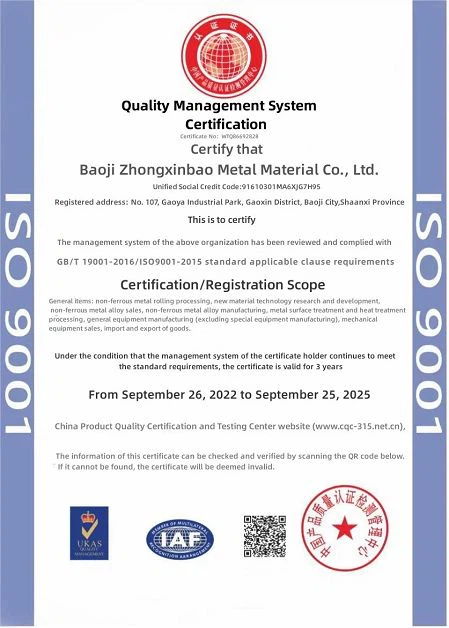
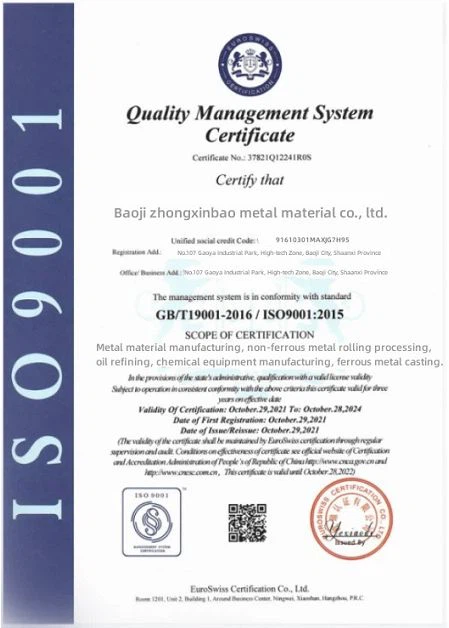
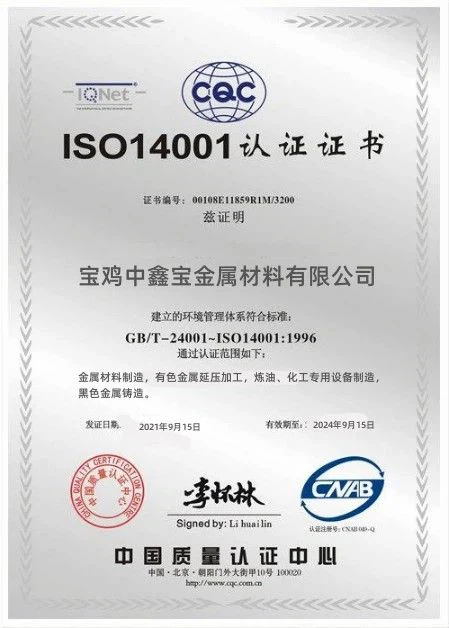
Our Certificates
FAQ
As one of the most professional titanium anode for sodium hypochlorite production manufacturers and suppliers in China, we're featured by quality products and good price. Welcome to buy titanium anode for sodium hypochlorite production for sale here and get pricelist from our factory. Also, customized service is available.
Sodium Hypochlorite Titanium Anode For Seawater Use, Industrial Grade Sodium Hypochlorite Titanium Anode, titanium anode for sodium hypochlorite production