


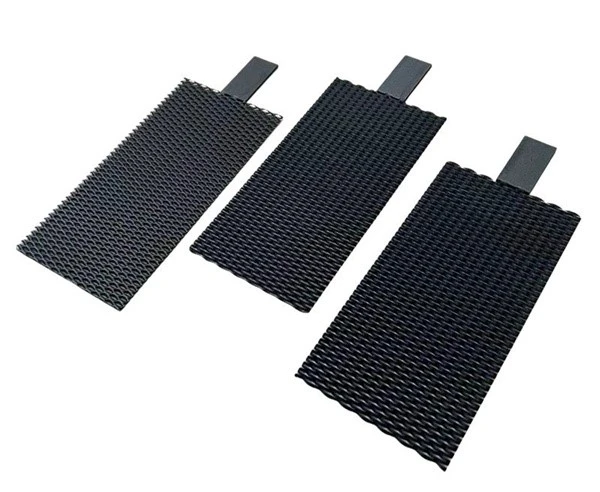
What Happens on the Titanium Anode Surface?
The titanium anode works by creating an anodic oxidation zone on the coated surface.
In electrochemical degradation, the purpose is usually to break down difficult organic matter, color, odor, or some process residues that are not easy to remove by simple filtration or settling. The wastewater passes through the cell, current is applied, and reactions happen near the anode surface.
The important part is the surface.
Bare titanium is not usually the working layer in this kind of system. It is used as the base. The coating is what faces the liquid and handles the reaction. That coating may be MMO, PbO2, Ir-Ta, or another coating system, depending on what the process needs.
For many wastewater projects, buyers first send an anode drawing and ask whether it can be made. Usually it can be made. The harder question is whether it should be made that way.
A plate, mesh, or tube shape only tells us how the anode fits into the cell. It does not tell us whether the coating can handle the actual liquid.
That is where many early problems start.
Why Does the Coating Decide the Degradation Result?
The coating decides what kind of anodic reaction the titanium anode is more likely to support.
Electrochemical degradation is not one fixed process. Some systems depend more on direct oxidation at the anode surface. Some rely partly on oxidizing species generated in the liquid. Some wastewater contains chloride, so chlorine-related oxidation may appear. Other liquids are mainly sulfate-based, acidic, alkaline, or mixed with unknown production chemicals.
The coating has to be selected around that condition.
PbO2 coated titanium anodes are often considered when the system needs strong oxidation for organic degradation or difficult wastewater treatment. But PbO2 is not a simple answer for every wastewater tank. It needs the right liquid condition, current density, and maintenance method.
MMO titanium anodes may also be used in some treatment systems. But MMO is only a broad name. Ru-Ir based coatings are often connected with chlorine evolution conditions. Ir-Ta coatings are more often discussed where oxygen evolution is the main reaction.
These differences are not small details.
If the wastewater contains chloride, the reaction path may be different from chloride-free water. If the liquid has heavy scaling tendency, the coated surface may become partly covered. If the pH changes during operation, the same anode may behave differently from the first test.
In real projects, we often see customers say, "The old anode was also titanium." That information helps, but it is not enough. The real question is: what coating was on it, what liquid was treated, and why did it fail?
Why Do Current Density and Flow Matter So Much?
A titanium anode may fail early if too much current is forced through too little active surface.
This is one of the most common issues in electrochemical degradation systems. The outside size of the anode looks large, but not all of it may be active. Some areas may be blocked by frames, holders, gaskets, clamps, or uncoated connection zones. Once the real active area is smaller than expected, the coating has to carry a heavier load.
At first, the system may still run.
Later, the voltage may rise. The degradation result may become weaker. The anode surface may show uneven color or local damage. Sometimes the customer thinks the coating quality is the only problem, but the real problem is high current density on a limited area.
Flow makes the situation worse or better.
If liquid moves evenly around the titanium anode, gas bubbles and reaction products are easier to move away from the surface. If flow is weak, bubbles stay near the coating. Deposits also build up faster. Then part of the surface stops working properly, and the remaining exposed area carries more current.
Wastewater is rarely clean. It may contain organic matter, hardness, suspended solids, oil, metal ions, salts, or other materials from production. Any of these can change the surface condition during operation.
The anode drawing may be correct. The cell may still not run well.
That is why active area, flow direction, electrode spacing, and liquid quality have to be checked together.
What Usually Causes Problems in Electrochemical Degradation?
Most problems come from overload, deposits, unstable wastewater, or cleaning damage.
The anode is only one part of the system. Even a suitable titanium anode can perform badly if the surrounding condition is not controlled.
A few problems show up often in actual use.
The first is surface blockage. Scale, sludge, organic residue, or gas bubbles cover part of the coating. The cell voltage goes up, and degradation efficiency drops.
The second is unstable liquid composition. Factory wastewater may change from day to day. One batch may have more chloride. Another may contain more oil or organic load. Cleaning chemicals from upstream production can also enter the wastewater. The titanium anode sees all of that.
The third is cleaning. Some operators clean the anode like a normal metal plate. Scraping, hard brushing, or strong chemical soaking can damage the coating. The titanium base may still look strong, but the working layer has already been affected.
Connection is another point that should not be ignored. A weak bolt, poor weld, dirty busbar, or small contact area can heat during operation. Sometimes the coating is acceptable, but the terminal becomes the weak point.
For electrochemical degradation systems, buyers should confirm these points before ordering:
What wastewater or process liquid will be treated?
What is the main degradation target?
Is chloride present?
What are the pH, temperature, and conductivity?
What current and voltage will be used?
What is the real active coated area?
Is the anode plate, mesh, tube, rod, or custom type?
How strong is the flow around the anode?
Is there scaling, sludge, oil, or suspended matter?
How will the anode be cleaned?
Is this a new system or a replacement anode?
For replacement titanium anodes, old photos are useful, but they do not tell the whole story. They can show size, shape, connection, and visible damage. They usually cannot show original coating type, actual current density, wastewater changes, or cleaning history.
A titanium anode works in electrochemical degradation systems by providing a coated surface for oxidation under current. The right anode should be selected around the real liquid, target pollutant, coating type, active area, current density, flow, and maintenance method.
Once these conditions are clear, the anode structure and coating direction become much easier to judge.
Related Reading:
How Does a Titanium Anode Work in Electrolytic Wastewater Treatment?