Engineering Product Overview
In many projects, Gr1 Titanium Rod is selected not for strength, but for predictability under corrosive or forming-intensive conditions. Compared with alloyed grades, Grade 1 titanium offers a wider processing window, stable surface behavior, and fewer variables during forming or secondary machining. This page covers Gr1 Titanium Rod supplied as an engineering material, typically used where corrosion resistance, ductility, and dimensional stability matter more than load-bearing capacity, making it a practical choice for systems that prioritize processing reliability and long-term material stability.
Application Scenarios

Chemical Processing Equipment
Used for corrosion-exposed components operating in aggressive chemical media and process environments.

Marine & Seawater Systems
Provides stable performance in chloride-rich seawater systems and offshore operating conditions.

Heat Exchanger Hardware
Used for tie rods, supports, fasteners, and machined components in heat exchanger assemblies where corrosion resistance and forming performance are required.

Electroplating Systems
Used for hooks, supports, connectors, and other fabricated components in plating equipment and surface-treatment systems.
Typical Specifications
|
Item |
Typical Range |
Engineering Notes |
|
Diameter |
Ø3-300 mm | Final range depends on diameter, length, surface condition, and processing requirements |
|
Length |
50-6000 mm, fixed-length or cut-to-length | Cut tolerance and end condition confirmed by order |
|
Condition |
Annealed |
Preferred for forming and bending |
|
Surface |
Pickled / Turned / Polished / Machined |
Surface choice affects corrosion initiation |
|
Straightness |
As agreed or according to drawing | Confirmed for machining or alignment-sensitive assemblies |
|
Standard |
ASTM B348 Gr1 |
Final acceptance per project requirement |
- All values shown are typical references and should be confirmed against project-specific needs.
Supply & Specification Scope
Material Grade:
- Titanium Grade 1 (Commercially Pure Titanium)
Supply Forms:
- Hot rolled or forged rod;
- Annealed condition for improved ductility;
- Straightened for machining or alignment-sensitive use
Size Logic:
- Common diameters supplied from small to medium sections;
- Length supplied as fixed mill length or cut-to-length;
- Tight tolerance or small-batch orders require prior confirmation
Applicable Standards:
- ASTM B348 (industrial titanium rod);
- Other standards may be referenced depending on application, subject to confirmation
Note:
- Final suitability depends on the actual service environment and downstream processing requirements.
Product Advantages and Practical Performance Characteristics
Quality Inspection

Dimensional Measurement

Mechanical Testing

Chemical Composition Analysis

Ultrasonic Flaw Detection
High Ductility:
- Supports forming operations with reduced risk of cracking or deformation defects.
Stable Corrosion Behavior:
- Forms a stable passive oxide film and performs well in many oxidizing and chloride-bearing environments when service conditions are suitable.
Low Material Variability:
- The commercially pure composition supports consistent forming and welding behavior.
Machining Predictability:
- Suitable for turning and light machining when tooling, cutting speed, and cooling conditions are properly controlled.
These characteristics make Gr1 suitable for designs that prioritize process reliability over mechanical strength.
Ordering, Packaging & Supply Notes


Minimum Order Quantity:
- Determined by diameter, length, and processing condition rather than a fixed quantity.
Lead Time:
- Influenced by size range, annealing requirements, and order volume.
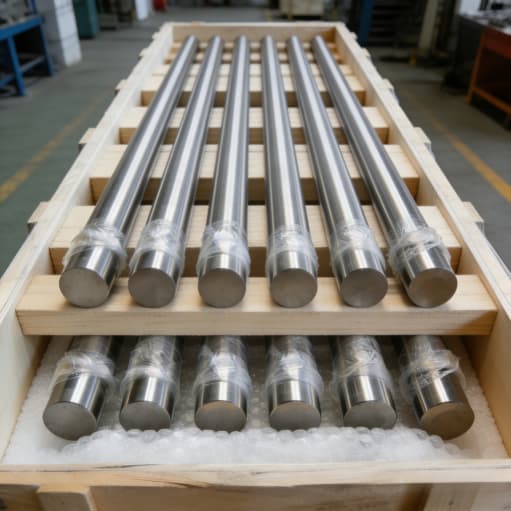
Packaging:
- Standard export packaging is used; additional protection can be arranged for surface-sensitive rods.
Inspection:
- Chemical composition and mechanical properties are supplied per applicable standards. Third-party inspection is available upon request.
Early clarification of application and processing requirements helps avoid unnecessary revisions during order execution.
Engineering FAQ
Q1: When is Gr1 preferred over Gr2?
A: Gr1 is typically selected when forming performance or corrosion resistance is more critical than strength.
Q2: Is Gr1 suitable for load-bearing structures?
A: No. Gr1 is not intended for high-stress or load-bearing structural applications.
Q3: Can Gr1 rods be supplied with tight tolerances?
A: Yes, but straightness and dimensional tolerance must be confirmed based on diameter and length.
Q4: Does annealing affect corrosion resistance?
A: Annealing mainly improves ductility. Corrosion resistance remains inherent to the Grade 1 material.
We Are Here For You
No. 107, Gaoya Industrial Park, High-Tech Zone, Baoji City, Shaanxi Province, China
Hot Tags: gr1 titanium rod, China gr1 titanium rod manufacturers, suppliers, factory