


A water treatment electrolyzer can start normally and still give unstable results after running for some time.
For titanium anodes in water treatment, the conditions that matter most are the target anodic reaction, water chemistry, current density based on the active coated area, flow, deposits, temperature, and electrical contact.
The titanium base holds the required shape and carries current to the coated surface. What happens after power is applied is mainly decided by the coating and the liquid around it.
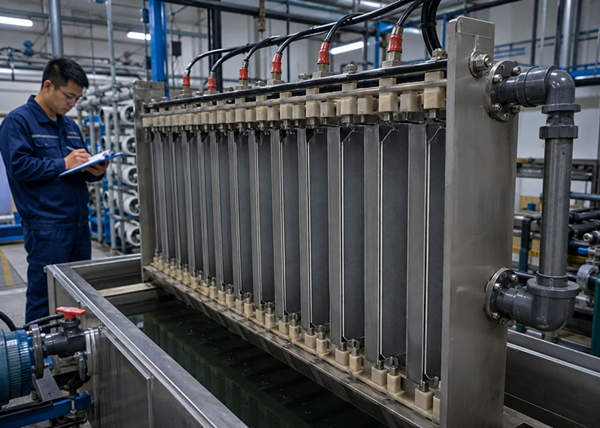
What Reaction Must the Titanium Anode Support?
The first condition to confirm is the reaction expected at the anode surface.
Some water treatment electrolyzers are designed to generate active chlorine from chloride-containing water. Others use anodic oxidation to reduce ammonia, break down organic contaminants, or support a broader electrochemical treatment process.
These systems may use similar-looking titanium anode plates or meshes, but the coating does not face the same reaction.
In a sodium hypochlorite generation system, chloride concentration is directly connected to the intended chlorine evolution process. Water conductivity, pH, temperature, flow, and the amount of current passing through the active surface also affect what happens inside the cell.
If the chloride level is too low or changes considerably between batches, oxygen evolution may compete more strongly with chlorine generation. The electrolyzer may continue drawing current while producing less of the oxidizing species expected by the process.
This is why the term MMO titanium anode is not enough for coating selection. MMO is a broad product category rather than one fixed coating formula.
Ru-Ir based coatings are often considered for chloride-containing systems where chlorine evolution is important. Ir-Ta based coatings are more commonly discussed when oxygen evolution is the main anodic duty.
These are useful starting directions, not absolute selection rules.
Wastewater oxidation needs a different discussion.
Chloride, sulfate, ammonia, organic compounds, suspended solids, and unknown process chemicals can all change the reaction at the coated titanium anode.
A coating selected for relatively clean saline water should not automatically be used for an industrial wastewater stream simply because both systems are described as water treatment.
Platinum coated titanium anodes may suit some clean and controlled electrolytes. PbO2 coated titanium anodes may be considered for certain strong anodic oxidation and organic degradation duties.
Neither coating is a general answer for every water treatment electrolyzer.
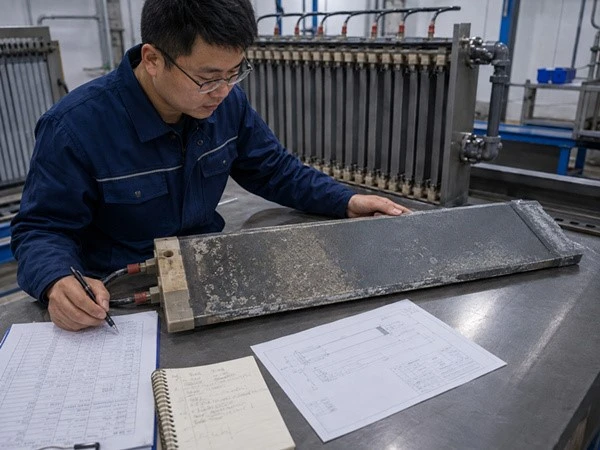
Why Must Current Density Follow the Active Coated Area?
The total current tells very little until it is related to the area that is actually coated and exposed to the water.
A drawing may show a titanium anode plate measuring 300 mm by 500 mm, but that does not mean the whole surface is electrochemically active.
Edges may be masked. One side may remain uncoated. Connection tabs, welded frames, bolt areas, and liquid-level margins may also be excluded from the working surface.
The same problem appears with titanium anode mesh, rods, discs, and tubular assemblies.
Suppliers and equipment designers may calculate mesh area differently, so the method used to define the active coated area should be agreed before current density is checked.
Twenty amperes applied to a large two-sided titanium anode plate is not the same operating condition as twenty amperes applied to a small coated rod.
The power supply shows the same current, but the coating load can be very different.
High current density may increase the reaction rate, but it can also produce heavier gas release, stronger local heating, greater voltage demand, and faster coating deterioration.
The effect is often concentrated near edges, corners, connection points, or areas facing a shorter electrode gap.
The average current density may look acceptable while a smaller part of the surface is carrying too much load.
Running at a very low current density is not automatically better.
The system may fail to produce enough oxidant, treatment time may increase, and the electrolyzer may operate outside the range for which it was designed.
The correct value should follow the target reaction, coating system, active area, water chemistry, flow, and required production rate.
Peak current also matters.
A unit that operates continuously at a steady load is different from one that starts and stops frequently or runs with pulsed current.
When the power supply has changing output, both normal current and maximum current should be provided before selecting titanium anodes for water treatment.
How Do Water Quality, Flow, and Deposits Change the Surface?
A coating can be suitable for the intended reaction and still perform poorly when the hydraulic condition is ignored.
Flow brings fresh electrolyte to the titanium anode surface and carries reaction products away.
It also helps gas bubbles leave the gap between the anode and cathode.
When bubbles remain attached to part of the surface, the effective contact between the coating and the liquid becomes uneven. Local current distribution and cell voltage may then change.
More flow is not always the answer.
Strong turbulence, abrasive particles, or poorly positioned inlet jets can create local wear or move deposits against the coated surface.
The real question is whether the water moves evenly through the active area without leaving stagnant zones.
Water hardness creates another problem.
Mineral precipitation often develops strongly around cathodic areas because of the local chemical conditions there, but the effect is not limited to the cathode.
Detached scale, narrow electrode gaps, poor circulation, and suspended deposits can obstruct the space around the titanium anode. This changes flow and can trap gas between the electrodes.
Industrial wastewater brings different deposits.
Iron compounds, suspended solids, oil, organic residues, and treatment chemicals may cover parts of the coated surface or collect around frames and mesh openings.
The titanium anode may still appear mechanically intact while its effective working area becomes smaller.
Cleaning should therefore be treated as part of the operating condition, not as an afterthought.
Hard scraping, grinding, wire brushing, or an unsuitable chemical cleaner may damage the coating even when the titanium base remains unchanged.
A cleaning method used for one MMO titanium anode should not be copied to another coating system without checking compatibility.
Temperature must also be recorded.
It changes solution conductivity, gas behavior, reaction rate, coating load, and the way deposits form.
A system tested with cool tap water may behave differently after installation in warm process water or a continuously circulating wastewater line.
One water sample is sometimes not enough.
Seasonal water changes, production chemicals, cleaning discharge, or variations in chloride and conductivity can expose the coated titanium anode to a wider operating range than the original specification suggests.

What Should Buyers Confirm Before Ordering?
A fabrication drawing is useful, but it leaves out most of the conditions that control electrochemical performance.
Before ordering titanium anodes in water treatment, buyers should normally confirm:
- The treatment purpose and intended anodic reaction
- Water or wastewater composition, including chloride, pH, conductivity, and major contaminants
- Normal current, maximum current, voltage range, and operating cycle
- Active coated area and whether one side or both sides will work
- Water temperature, flow direction, and expected flow variation
- Anode-to-cathode spacing and the number of electrodes in the cell
- Scaling, fouling, and the planned cleaning method
- Connection structure, busbar contact, and lead position
- Existing coating information when replacing an old titanium anode
- The reason the previous anode is being replaced
The replacement reason deserves more attention than it usually receives.
An old sample can show dimensions, holes, welds, mesh openings, lead position, and installation shape.
It cannot explain whether the old coating was correct, whether the active area was sufficient, or whether the previous unit failed because of current concentration, cleaning damage, scale, poor contact, or a change in water chemistry.
Electrical connection should be checked at the same time as the coated surface.
A loose busbar connection, small contact area, contaminated contact face, or undersized lead can create heat and voltage loss before current reaches the active coating.
Replacing the coated section alone will not correct that problem.
Electrode spacing also belongs in the operating specification.
A narrower gap can reduce electrical resistance, but the cell still needs enough space for water movement, gas release, installation tolerance, and deposit control.
A gap copied from another electrolyzer may not suit a different flow rate or water quality.
The required treatment result should be expressed in measurable system terms where possible.
This may include target active chlorine output, ammonia reduction, contaminant removal, flow capacity, treatment time, or another process requirement.
The anode supplier can then review whether the proposed coating, active area, structure, and electrical load are consistent with that duty.
For titanium anodes in water treatment, water chemistry and current density are usually the first two conditions to check, but they do not work alone.
Flow, gas release, temperature, deposits, cleaning, electrode spacing, and electrical contact can change the result even when the anode drawing is correct.
Once these conditions are clear, selecting the coating and active structure becomes a much more practical engineering decision.
ZXB Company Introduction
Baoji Zhongxinbao supplies custom titanium anodes for water treatment, sodium hypochlorite generation, wastewater electrolysis, and other industrial electrochemical systems.
Coating type, active area, titanium structure, connection design, and custom dimensions can be reviewed together with the actual water chemistry and operating conditions before quotation.
FAQ
Q1: What Is The Most Important Condition When Selecting Titanium Anodes For Water Treatment?
A: The intended anodic reaction should be confirmed first. Water chemistry and current density based on the actual active coated area are then two of the most important operating conditions to review.
Q2: Is MMO One Fixed Coating For Water Treatment Titanium Anodes?
A: No. MMO describes a broader family of mixed metal oxide coatings rather than one fixed composition. The coating system should match the intended reaction, electrolyte, current loading, and operating environment.
Q3: Why Should Buyers Provide The Active Coated Area Instead Of Only Total Anode Dimensions?
A: Because current density depends on the surface actually coated and exposed to the electrolyte. Masked edges, uncoated sides, tabs, frames, and connection areas can significantly change the real working area.
Q4: What Information Should Be Provided For A Replacement Water Treatment Titanium Anode?
A: Provide the drawing, water chemistry, current and voltage range, active coated area, electrode spacing, cleaning method, coating information if known, and the reason the previous anode is being replaced.
Contact Us
For Titanium Anode for Water Treatment enquiries, drawings, or custom requirements:
Email: jack@zxb-titanium.com
Please include the grade, dimensions, quantity, application, and required standard where available.