

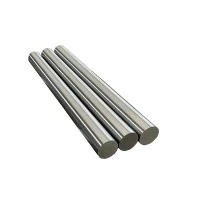


When people talk about titanium bar in vehicle applications, the first reaction is often the same. Too expensive. Too special. Probably only for aerospace or racing.
That is partly true.
For most ordinary passenger vehicles, titanium is still not a volume material. But in new energy vehicles, especially where weight, corrosion risk, thermal load, or performance margin all start to matter at the same time, titanium bar does show up in some specific parts.
Usually not everywhere. Usually in the places where common steel starts becoming a compromise.
1. Fuel cell systems
This is one of the more realistic areas for titanium-related discussion.
In hydrogen fuel cell systems, the operating environment is not simple. Moisture, electrochemical reaction, sealing reliability, corrosion resistance, and long-term stability all sit close together. That is why titanium comes into the conversation more often here than in many standard battery-electric structures.
Some machined parts made from titanium bar can be used in support components, connector hardware, and selected corrosion-sensitive structural details around the fuel cell system.
People sometimes extend this too far and make it sound as if titanium bar is the default answer for the whole stack.
Usually it is not.
What does happen is that titanium becomes attractive in parts where corrosion resistance and weight reduction need to be balanced together, especially in areas where failure or leakage would be difficult to accept later.
Hydrogen line connection hardware is another example people look at. Flanges, fittings, or selected machined connectors may use titanium in some designs, especially where pressure, corrosion resistance, and service reliability all matter at once.
2. Battery pack structures and supporting hardware
In battery-electric vehicles, titanium bar is usually not a mainstream material for the whole battery pack structure. Cost alone already limits that.
Still, there are some cases where it enters the design discussion.
Support columns, reinforcement details, special fasteners, and some machined hardware in battery pack assemblies may use titanium alloy bar when the target is to reduce mass without giving up too much strength.
This is more likely in higher-end vehicles, performance-focused platforms, or projects where every kilogram starts being counted more seriously.
The same goes for selected parts in battery cooling or sealing-related assemblies. Not because titanium has the best thermal conductivity. It does not. More because in some environments it gives a useful mix of corrosion resistance, structural reliability, and reduced maintenance concern.
So in battery systems, titanium bar is usually an auxiliary material, not the main structural one.
But in the right place, it can still make sense.
3. Lightweight structural parts
This is probably where people expect titanium bar to appear first.
New energy vehicles are always under pressure to reduce weight. More range. Better efficiency. Less energy loss in repeated acceleration and braking. That logic is straightforward.
But lightweighting by itself is not enough reason to use titanium. Otherwise it would already be everywhere.
Titanium bar starts becoming realistic when a part is not only weight-sensitive, but also highly loaded, corrosion-exposed, or expected to keep reliable mechanical performance over a long service cycle.
That is why some higher-end or more specialized vehicle programs look at titanium alloy bar for suspension members, steering-related parts, fasteners, and selected load-bearing brackets.
The point is not that titanium should replace all steel chassis parts. In most vehicles, that would not be practical.
The point is that in certain high-stress locations, a lighter material with good strength and corrosion behavior may justify itself, especially when performance targets are already aggressive.
4. Motor and electric drive hardware
This area needs a bit of restraint, because it is easy to overstate.
Titanium bar is not a standard material for all motor shafts or drive components. In many cases, alloy steel remains the more realistic choice.
Still, in some high-performance designs, titanium alloy bar may be considered for selected rotating or support components where lower mass helps reduce inertia and improve response.
This is not only about making the vehicle lighter. In rotating parts, mass distribution matters differently. A reduction there can affect response behavior more directly than in a static bracket somewhere else in the vehicle.
Even so, the material decision has to be made carefully. Strength, stiffness, fatigue, machining cost, and joining method all enter the discussion. So titanium is only used where the design benefit is clear enough.
Some smaller support parts, fastening hardware, or temperature-exposed components in motor and control-related systems may also use titanium where corrosion resistance and cyclic thermal stability are both important.
Again, not as a default. Only where the trade-off makes sense.
5. Why titanium bar is still selective in new energy vehicles
This part matters.
It is easy to write a list of possible applications and make it sound as if titanium bar is spreading through the whole vehicle. In practice, it stays selective.
The reason is simple.
Titanium solves some real problems. Weight. Corrosion. Strength-to-weight ratio. Stability in certain difficult environments.
But it also brings cost, machining difficulty, and design trade-offs.
So in most vehicle projects, titanium bar is used only where several requirements overlap:
● weight reduction matters
● strength cannot drop too much
● corrosion risk is real
● long-term reliability matters
● the cost can still be justified
That is usually the decision logic.
Not whether titanium sounds advanced, but whether it solves a combined engineering problem better than the usual materials.
6. Where the real value usually appears
In new energy vehicle work, titanium bar is rarely chosen because of one single property.
Usually it is chosen when several pressures show up in the same part:
- lower mass
- enough strength
- corrosion resistance
- good service life
- stable behavior under repeated load or thermal cycling
That is where titanium starts to become realistic.
So if someone asks whether titanium bar has applications in new energy vehicles, the answer is yes.
But not in a broad, universal way.
It is more accurate to say this:
Titanium bar is used in selected fuel cell hardware, battery pack support parts, lightweight structural details, and some motor or control-related components where common materials start running into limits.
That is usually how it enters the vehicle.
Not as a general replacement material. More as a targeted solution in the parts where the trade-off finally works in its favor.
Related technical discussion: