


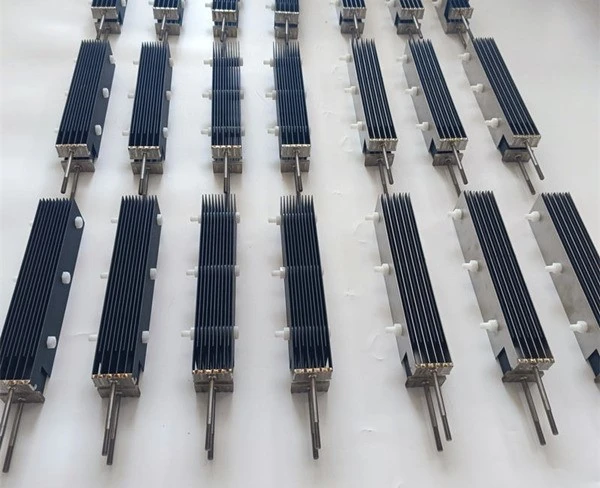
A seawater hypochlorite cell does not always warn the operator with a visibly damaged anode.
The first complaint may be different. The cell needs more voltage than before. Hypochlorite output begins to fall. Cleaning becomes more frequent. One electrode shows much heavier deposits than the others.
At that point, the Titanium Anode is often blamed first.
Sometimes the coating really is reaching the end of its useful life. In many seawater systems, however, the problem begins somewhere else in the electrolyzer.
A Rising Cell Voltage Does Not Automatically Mean the Anode Has Failed
Seawater brings calcium and magnesium into the cell. During electrolysis, hydroxide is generated around the cathode and the local pH rises. This encourages mineral precipitation.
Magnesium- and calcium-containing deposits gradually build up around the cathodic side of the electrode assembly.
That distinction matters. The typical seawater scale problem does not begin because calcium and magnesium are simply attacking the MMO anode coating.
But once deposits begin filling the electrode gap, the whole cell is affected. The electrolyte passage becomes narrower. Electrical resistance can increase. Flow through one section may no longer match another.
The rectifier then needs more voltage to maintain the same current. From the control panel, this can look very much like an anode problem.
The coating may still be usable.
A replacement anode installed into the same heavily scaled cell may initially appear to improve performance simply because the electrolyzer was cleaned during the maintenance work.
For troubleshooting, it is therefore useful to inspect the cathode and electrode gap before concluding that the MMO coating has failed.
Seawater Flow Changes What the Electrodes See
A seawater electrochlorination cell is a flow-through piece of equipment.
Fresh seawater enters the electrolyzer, current passes between the electrodes, and the outlet contains the hypochlorite solution together with gases generated during electrolysis.
If the flow is lower than the design value, several things change at once:
- Gas removal becomes less effective.
- The local concentration around the electrodes can shift.
- Deposits have more opportunity to accumulate in restricted areas.
- Temperature can also rise more than expected.
The result is rarely a perfectly uniform electrode surface. One part of the cell may remain relatively clean while another develops heavy scale.
That pattern is useful.
If several replacement anodes repeatedly show problems in the same physical position, it is worth looking at the cell hydraulics and installation before changing the coating specification again.
Electrode spacing belongs to the same discussion. A narrow gap can reduce part of the electrical resistance when the cell is clean. Once scale begins occupying that gap, the advantage can disappear quickly.
So a replacement electrode should normally preserve the designed geometry rather than being made thicker or repositioned casually.
The Coating Can Still Be the Real Problem
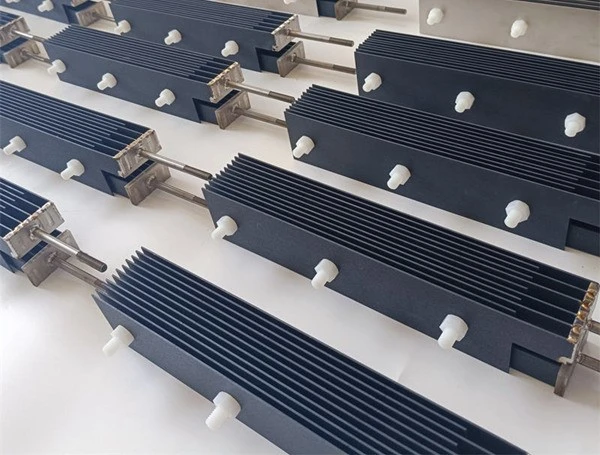
Seawater sodium hypochlorite production is a chlorine-evolution application. The anode has to oxidize chloride efficiently under the intended operating conditions.
Ru-based MMO coatings, commonly including Ru-Ir systems, are widely used for this work.
The coating is not only there to protect the titanium. It is the electrochemically active surface.
If the active layer is gradually lost, the electrode begins to change electrically. Current that was originally distributed across an active MMO surface may become concentrated on the remaining coated regions.
More of the titanium substrate can eventually become exposed. The operator may notice increasing voltage or decreasing chlorine output before the anode looks severely damaged.
Local wear deserves attention too.
An anode can have an acceptable average current density while one part of the surface is working harder because of electrode geometry or uneven current distribution.
This is why coating life should not be judged from total current alone. The real coated area matters. So does the way the electrodes face each other inside the cell.
If the required production output has been increased since the equipment was commissioned, the old anodes may now be operating above their original loading even though their dimensions have never changed.
More Current Does Not Always Give a Better Operating Point
Increasing current normally increases chlorine production. That is useful until the rest of the cell no longer keeps up.
Higher current means higher current density on the active surface. More gas is generated. The electrolyte can become warmer. Electrical efficiency may fall even while chlorine output continues to rise.
This becomes important when a plant wants more sodium hypochlorite from an existing electrolyzer without changing the electrode area.
The production target has changed. The anode has not.
Running the same MMO surface at a substantially higher load can accelerate coating consumption and expose weak areas sooner. It can also make scaling and gas-release problems more noticeable.
For an existing system, it is useful to compare the current being used today with the original operating condition.
A coating described as having "short life" may actually have spent most of that life above the duty for which the cell was originally designed.
Reverse-Polarity Cleaning Needs the Right Electrode System
Seawater electrochlorination equipment often needs a strategy for controlling mineral buildup.
Chemical cleaning is one approach. Some modern systems use automatic polarity reversal.
This can reduce manual cleaning because the electrode that was previously operating cathodically changes polarity, helping deal with deposits formed during the previous cycle.
But reverse polarity changes the electrical duty of the electrodes. An electrode that was an anode becomes a cathode for part of the operating cycle.
That is not the same service as continuous one-direction anodic operation.
The coating system therefore needs to be selected for the actual electrolyzer design. A standard electrode developed only for permanent anodic operation should not automatically be assumed suitable for repeated polarity reversal.
This point is especially important for replacement projects.
A buyer may send an old titanium plate and ask for the same dimensions without mentioning that the machine changes polarity automatically every few hours.
Mechanically, the copy may be correct. Electrochemically, a major part of the specification is missing.
Cleaning Can Create a New Problem
Scale has to be removed. The way it is removed matters.
A coated titanium electrode is not an ordinary titanium plate. The MMO layer is the working surface, and aggressive mechanical cleaning can damage it.
Hard scraping, grinding, or abrasive treatment may remove active material together with the deposit. Chemical cleaning also needs to match the electrode system and the scale being removed.
If one anode repeatedly needs aggressive cleaning, the coating can gradually lose useful area even though the original problem was mineral buildup rather than coating instability.
This can create a confusing maintenance history.
First the cell scales. Then the electrodes are cleaned aggressively. Later, the coating deteriorates.
At that stage both problems exist at the same time.
For a used electrode, photos taken before cleaning can therefore be more informative than a perfectly cleaned sample sent to the supplier.
Sometimes the Problem Is Above the Electrolyte
The electrical connection deserves a separate look.
Current has to move from the rectifier and busbar into the titanium structure before it reaches the MMO surface.
A loose contact or increasing connection resistance can create heat and voltage loss. The active coating farther down the electrode may still be normal.
For a large seawater electrolyzer, a discolored terminal or hot connection should not be treated as a coating-life problem.
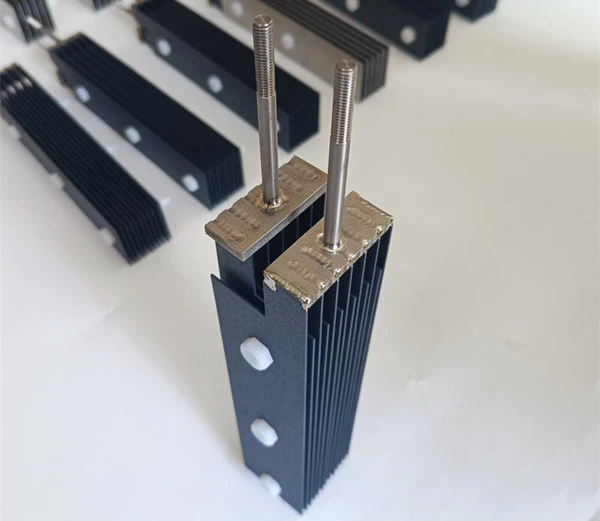
The current-feed design also matters when a custom anode is manufactured.
Connection sections normally remain uncoated, but they still need enough titanium cross-section and reliable electrical contact to carry the operating current.
This is one reason a replacement drawing should include the complete anode assembly rather than only the submerged coated portion.
What Should Be Checked Before Replacing the Anode?
The used electrode is useful evidence. Do not look only at how much coating remains. Look at where the problem appeared.
Heavy mineral deposits suggest one line of investigation. Even coating wear over a long operating period suggests another. A damaged connection points somewhere else.
If the customer reports declining hypochlorite output, it is also worth checking whether current, seawater flow, salinity, temperature, and cell voltage have changed from the original operating condition.
For a replacement Titanium Anode for Seawater Hypochlorite Production, useful information normally includes:
- Existing electrode drawing
- Active coated area
- Operating current
- Seawater condition
- Cell configuration
- Cleaning method
- Polarity mode
- Reason for replacement
The goal is not to collect every possible operating parameter. It is to avoid solving a cell problem by simply ordering a more expensive coating.
ZXB Company Introduction
Baoji Zhongxinbao supplies custom Ru-Ir coated titanium anodes for seawater electrochlorination and sodium hypochlorite generation.
For replacement projects, electrode condition, active area, current loading, polarity mode, and cell geometry can be reviewed together before the new specification is finalized.
FAQ
Q1: Does Seawater Scale Mean The Titanium Anode Has Failed?
A: No. Much of the characteristic calcium- and magnesium-related scale develops because of the alkaline condition near the cathode. The deposits can still increase cell voltage and interfere with the entire electrode assembly.
Q2: Why Can Hypochlorite Output Fall While The Anode Still Looks Normal?
A: The cause may be scaling, reduced flow, changing electrode spacing, coating deactivation, current-distribution problems, or another change in the electrolyzer. Visual appearance alone does not identify the cause.
Q3: Can Reverse Polarity Help Control Scaling?
A: Yes. Purpose-designed seawater electrochlorination systems use reverse polarity as a self-cleaning strategy. The electrodes and coatings must be suitable for repeated polarity changes.
Q4: Should A Worn Seawater Anode Simply Be Replaced With A Heavier MMO Coating?
A: Not automatically. If the original problem came from excessive current loading, scale, poor flow, connection resistance, or unsuitable cleaning, increasing coating loading alone may not solve it.
Contact Us
For Titanium Anode for Seawater Hypochlorite Production enquiries, drawings, or custom requirements:
Email: jack@zxb-titanium.com
Please include the grade, dimensions, quantity, application, and required standard where available.
Related Reading
How Do You Choose A Titanium Anode For Sodium Hypochlorite Generation?