


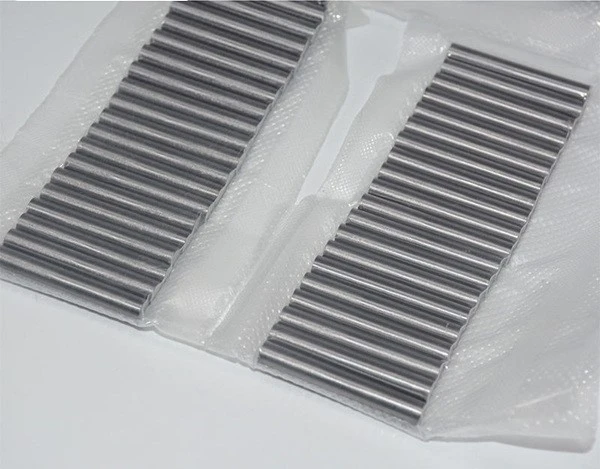
How Much Larger Should the Rod Be Than the Finished Diameter?
Start with the largest finished diameter on the drawing.
If a component finishes at 20 mm, ordering a 20 mm Ta1 Tantalum Rod leaves practically no room to establish a clean machined surface.
The workshop still needs to remove the original rod surface, correct small dimensional variation, and create a concentric outside diameter.
The raw diameter should therefore include machining stock.
How much is needed depends on the part.
A short pin with a simple turned OD does not need the same allowance as:
- A long shaft
- A component with several concentric diameters
- A threaded part
- A grooved part
- A component that will be ground after turning
- A part with narrow tolerances or thin remaining sections
Surface condition also affects the decision.
A light superficial mark may disappear during the first turning pass. A deeper defect can consume more of the available diameter before the complete circumference cleans up.
Using an excessively large rod creates the opposite problem.
Tantalum is a dense and relatively expensive material. Turning a much larger diameter down to a small finished part produces unnecessary chips and increases machining time.
For repeated production, choosing a closer raw diameter can make a noticeable difference in material yield.
This is why the finished drawing is useful even when the customer only wants raw Ta1 Tantalum Rod.
The supplier can compare the maximum finished OD with practical starting sizes rather than quoting the nearest available diameter blindly.
Length needs machining allowance too
A 100 mm finished component normally requires more than 100 mm of raw rod.
The machine may need material for:
- Facing
- Chucking
- Cutoff
- Centre drilling
- Tailstock support
- Grinding allowance
- Saw kerf
If several parts will be cut from one longer rod, spacing between the blanks also needs to be included.
For expensive tantalum stock, cutting plans are worth checking before the order is placed.
One longer rod may provide better material yield for a production batch. In another job, individual cut blanks may reduce handling and leave less unusable material at the end of the bar.
Neither route is always better.
The cutting plan should follow the actual machining process.
Why Does Straightness Matter Before Turning?
Straightness becomes more noticeable as the ratio between rod length and diameter increases.
A short, heavy Ta1 Tantalum Rod can often be faced and turned without much difficulty even if the raw bar is not perfect.
A long, smaller-diameter rod behaves differently.
Once it rotates in the machine, bow in the raw material becomes runout.
The operator may then need to:
- Reduce the unsupported length
- Use a steady rest
- Use tailstock support
- Straighten the rod before machining
- Divide the rod into shorter blanks
- Remove additional material during turning
Any of these steps changes the production route.
This matters when the finished component has a long concentric section.
Imagine a drawing with a relatively small final OD extending over most of the part length.
If the incoming Tantalum Rod already has noticeable curvature, turning enough material to clean the entire circumference may remove more stock than expected.
The original diameter allowance and straightness requirement therefore work together.
A buyer should not automatically request extremely tight straightness on every rod.
That can add unnecessary processing when the material will immediately be cut into short blanks.
For long shafts, electrodes, threaded components, or parts machined between centres, straightness deserves more attention.
The quotation should make clear whether the rod will be:
|
Machining Route |
Why It Matters |
|---|---|
|
Machined as one long length |
Straightness and runout become more important |
|
Cut into short blanks first |
General raw-bar straightness may be sufficient |
|
Centreless ground |
Diameter allowance and straightness must support grinding |
|
Turned between centres |
Bow and concentricity require closer review |
|
Held in a chuck with tailstock support |
Unsupported length and raw straightness both matter |
|
Used with only limited machining |
Original OD and surface condition become more important |
That information helps the supplier judge whether ordinary supplied straightness is likely to be enough or whether additional straightening should be discussed.
Cut length also affects transport.
Long, relatively small-diameter tantalum rods need sufficient support inside the case.
A rod that leaves production straight can still arrive bent if it moves freely during shipping or is packed beneath heavier material.
How Much of the Original Surface Will Remain?
Some machining jobs remove the complete outside surface.
Others do not.
That difference should be stated before the raw rod is purchased.
If a Ta1 Tantalum Rod will be fully turned down over its entire length, minor superficial marks on the raw surface may disappear during machining.
The important question is whether those marks are shallow enough to remain inside the planned machining allowance.
A deeper longitudinal defect is different.
If the operator has to continue turning until the defect disappears, the finished diameter may fall below the drawing requirement.
Increasing the raw diameter can provide more cleanup stock, but severe defects should not simply be accepted because machining is planned.
Partial machining requires closer surface control
A drawing may require one end to be threaded while the centre section remains at the original rod diameter.
Another component may have two machined shoulders but leave the middle section untouched.
In these cases, part of the supplied rod surface becomes part of the finished product.
The buyer should identify that area rather than request a vague "good surface."
More useful descriptions include:
- Full OD will be turned
- Centre section remains as supplied
- Only the ends will be machined
- Rod will be ground to final diameter
- Threaded area will be machined
- Original OD remains on the finished component
Surface wording should follow the actual operation.
A raw section that remains exposed may need closer visual control.
A section that will be turned down by several millimetres has different acceptance needs.
A sealing or fitted surface should normally be created by the specified finishing operation rather than relying on the original supplied surface.
Ends deserve attention as well.
Saw-cut ends are usually sufficient when the machine shop will face the blank.
If the supplied length is already close to final size, the buyer may require more controlled end cutting or squareness.
For CNC machining, the workshop may also need a clean reference end before establishing the first datum.
Does the Material Condition Match the Machining Route?
Ta1 Tantalum Rod is ductile, and its machining behaviour is not the same as a free-cutting steel.
Tooling, cutting conditions, chip control, workholding, and material condition all affect the result.
A drawing with narrow grooves, deep internal features, threads, or thin remaining walls deserves a machining review before the raw diameter is fixed.
The purpose of the allowance is to give the workshop enough material to reach the drawing.
It should not be used to hide an unsuitable raw surface or supply condition.
Material condition also matters when other operations follow machining.
A more heavily cold-worked rod and an annealed rod will not behave identically during later:
- Bending
- Swaging
- Threading
- Forming
- Further cold work
If the finished part includes one of these operations, the required material condition should be stated rather than assumed from the grade name alone.
What Should Be Written on the Tantalum Rod Order?
"Ta1 Tantalum Rod, 25 mm dia." is enough for a rough price check.
It leaves too much open for a machining order.
The buyer should first confirm the material requirement.
If the project uses the Ta1 designation, the required chemistry or applicable material specification should be shown clearly.
ASTM B365 is commonly referenced for tantalum and tantalum-alloy rod and wire and includes unalloyed tantalum grades such as UNS R05200 and R05400.
Ta1 and an ASTM UNS grade should not automatically be treated as interchangeable names without checking the chemistry required by the project.
A practical machining-stock enquiry should include:
|
Item |
Information to Confirm |
|---|---|
|
Material |
Ta1 or specified tantalum chemistry |
|
Standard |
ASTM B365 or another required specification |
|
Raw Diameter |
Nominal rod diameter and tolerance |
|
Finished Diameter |
Maximum finished OD |
|
Machining Allowance |
Stock for turning, cleanup, and grinding |
|
Raw Length |
Full rod or individual cut length |
|
Finished Length |
Where relevant to cut planning |
|
Cutting Plan |
Saw kerf, facing, cutoff, and gripping allowance |
|
Straightness |
Requirement where long parts are involved |
|
Original Surface |
Whether any supplied OD remains on the finished part |
|
Surface Condition |
Raw, cleaned, ground, machined, or project-defined |
|
Material Condition |
Annealed or other specified condition |
|
End Condition |
Saw cut, faced, machined, or drawing-defined |
|
Machined Features |
Threads, grooves, shoulders, holes, or thin sections |
|
Quantity |
Number of rods or blanks |
|
Drawing |
Finished-part drawing and revision |
|
Traceability |
Heat or batch identification |
|
Documents |
Material certificate and agreed inspection records |
|
Packing |
Support for long rods and protection of finished surfaces |
The drawing can save material.
If the supplier knows that a 32 mm Ta1 Tantalum Rod will finally become a 30 mm shaft, the starting size may be straightforward.
If the largest finished feature is only 20 mm, starting from 32 mm may waste considerably more tantalum than necessary.
For irregular parts, the maximum OD is only part of the calculation.
The following can change the preferred blank size:
- Chucking length
- Shoulders
- Threads
- Grooves
- Grinding allowance
- Cutoff positions
- Support points
- Sections remaining at raw diameter
This is particularly relevant for small batches.
A few kilograms of unnecessary raw tantalum may represent more cost than the additional cutting or preparation needed to supply closer blanks.
Ta1 Tantalum Rod for machining should therefore be selected from the finished drawing backward.
First establish the largest finished section. Then leave enough stock for cleanup and machining.
Straightness should reflect the actual unsupported length, while the surface requirement should depend on how much of the original rod remains after turning.
The best raw rod is not necessarily the closest size or the largest available size.
It is the one that gives the machine shop enough material to finish the part without paying to turn away tantalum that was never needed.
Related Reading