


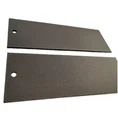



What is the role of titanium substrate in a Mesh Platinum - Coated Titanium Anode?
As a supplier of Mesh Platinum - Coated Titanium Anodes, I've witnessed firsthand the growing demand for these high - performance anodes in various industries. One of the most frequently asked questions is about the role of the titanium substrate in a Mesh Platinum - Coated Titanium Anode. In this blog, I'll delve into the details of why titanium is the preferred substrate and its crucial functions in the overall performance of the anode.
Why Titanium as a Substrate?
Titanium is a unique metal that offers several properties that make it an ideal choice for the substrate of a Mesh Platinum - Coated Titanium Anode. First and foremost, titanium has excellent corrosion resistance. In many electroplating and electrochemical applications, the anode is exposed to highly corrosive environments, such as acidic or alkaline solutions. Titanium can form a passive oxide layer on its surface when in contact with these corrosive substances. This oxide layer acts as a protective barrier, preventing the underlying titanium from further corrosion. For example, in the process of Chrome Plating, the plating bath often contains strong acids. A titanium substrate can withstand the harsh chemical environment, ensuring the long - term stability of the anode.
Another significant advantage of titanium is its high strength - to - weight ratio. Titanium is relatively lightweight compared to many other metals, yet it has high mechanical strength. This property is particularly important for mesh - type anodes. The mesh structure needs to maintain its shape and integrity during the electroplating process, which involves the flow of electric current and the movement of ions in the solution. The high strength of titanium allows the mesh to resist deformation, ensuring uniform current distribution across the anode surface.
The Role of Titanium in Adhesion
The titanium substrate plays a vital role in providing a good adhesion surface for the platinum coating. The adhesion between the platinum layer and the titanium substrate is crucial for the performance and longevity of the Mesh Platinum - Coated Titanium Anode. Titanium has a surface chemistry that allows for strong bonding with platinum. During the coating process, the platinum particles can adhere firmly to the titanium surface, forming a continuous and stable coating.


A well - adhered platinum coating is essential for several reasons. Firstly, it ensures efficient electron transfer between the anode and the electrolyte. When an electric current is applied to the anode, electrons need to flow smoothly from the platinum coating to the electrolyte. A strong bond between the platinum and titanium substrate facilitates this electron transfer process, reducing the electrical resistance of the anode. Secondly, a good adhesion prevents the platinum coating from peeling off or flaking during the operation of the anode. If the platinum coating detaches from the titanium substrate, it can lead to uneven current distribution, reduced anode efficiency, and even premature failure of the anode.
Electrical Conductivity and Titanium Substrate
Although titanium is not as conductive as some metals like copper or silver, it still has sufficient electrical conductivity to serve as a substrate for a Mesh Platinum - Coated Titanium Anode. The titanium substrate acts as a conductor that transfers the electrical current from the power source to the platinum coating.
In an electrochemical cell, the anode needs to be able to conduct electricity effectively to drive the oxidation reactions at the anode surface. The titanium substrate provides a pathway for the current to reach the platinum coating, where the actual electrochemical reactions occur. The combination of the titanium substrate's conductivity and the high catalytic activity of the platinum coating results in an anode with excellent electrochemical performance.
Moreover, the conductivity of titanium can be further optimized through proper surface treatment and alloying. For example, some manufacturers may use specific heat - treatment processes to improve the electrical properties of the titanium substrate, enhancing the overall performance of the Mesh Platinum - Coated Titanium Anode.
Thermal Stability
Thermal stability is another important aspect where the titanium substrate contributes to the performance of the Mesh Platinum - Coated Titanium Anode. In many electrochemical processes, heat is generated due to the flow of electric current and the electrochemical reactions taking place at the anode. The titanium substrate can withstand high temperatures without significant degradation.
The ability to maintain its mechanical and chemical properties at elevated temperatures is crucial for the anode's long - term operation. For instance, in some high - current electroplating applications, the temperature of the anode can rise significantly. A titanium substrate with good thermal stability ensures that the anode structure remains intact, and the platinum coating adheres well, even under high - temperature conditions.
Impact on Anode Performance
The role of the titanium substrate has a direct impact on the overall performance of the Mesh Platinum - Coated Titanium Anode. A high - quality titanium substrate can enhance the anode's efficiency, durability, and catalytic activity.
In terms of efficiency, as mentioned earlier, the titanium substrate's conductivity and its ability to provide a good adhesion surface for the platinum coating contribute to efficient electron transfer and uniform current distribution. This results in a more efficient electrochemical process, reducing energy consumption and improving the quality of the electroplated products.
Durability is also greatly influenced by the titanium substrate. The corrosion resistance and mechanical strength of titanium ensure that the anode can withstand the harsh operating conditions over an extended period. This reduces the frequency of anode replacement, saving costs for the end - users.
The catalytic activity of the anode is mainly determined by the platinum coating, but the titanium substrate also plays a supporting role. A stable and well - functioning titanium substrate provides a reliable platform for the platinum coating to exhibit its catalytic properties, facilitating the desired electrochemical reactions.
Applications of Mesh Platinum - Coated Titanium Anodes
Mesh Platinum - Coated Titanium Anodes are widely used in various industries due to their excellent performance. In the electroplating industry, they are used for Platinum Coated Titanium Anodes applications such as decorative plating, functional plating, and corrosion - resistant plating. The uniform current distribution provided by the mesh structure and the high catalytic activity of the platinum coating result in high - quality plated products.
In the field of water treatment, these anodes are used for electrochemical oxidation processes. The Mesh Platinum - Coated Titanium Anode can generate strong oxidizing agents such as hydroxyl radicals, which can effectively remove organic pollutants, heavy metals, and microorganisms from water.
Conclusion
In conclusion, the titanium substrate in a Mesh Platinum - Coated Titanium Anode plays a multifaceted and crucial role. Its corrosion resistance, high strength - to - weight ratio, ability to provide good adhesion for the platinum coating, electrical conductivity, thermal stability, and impact on anode performance make it an indispensable component of the anode.
As a supplier of Mesh Platinum - Coated Titanium Anodes, we understand the importance of using high - quality titanium substrates to ensure the best performance of our products. If you are interested in our Mesh Platinum - Coated Titanium Anodes or have any questions about their applications, please feel free to contact us for further discussion and procurement negotiations.
References
- "Electrochemical Engineering Principles" by Carl R. Newman and Karen E. Thomas --Alyea.
- "Corrosion and Corrosion Control" by Mars G. Fontana.
- Industry reports on electroplating and electrochemical applications.