


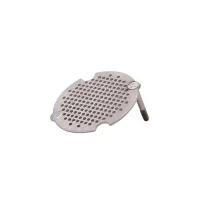


Hey there! As a supplier of MMO Coated Titanium Disc Anodes, I often get asked about the quality standards of these anodes. So, I thought I'd share some insights on what makes a high - quality MMO Coated Titanium Disc Anode.


First off, let's understand what an MMO Coated Titanium Disc Anode is. MMO stands for Mixed Metal Oxide. These anodes are made by coating a titanium disc substrate with a layer of mixed metal oxides. They're widely used in cathodic protection systems, electroplating, and other electrochemical processes.
Substrate Quality
The titanium substrate is the foundation of the MMO Coated Titanium Disc Anode. High - quality titanium is crucial. It should have a low iron content. A high iron content can lead to increased corrosion of the substrate, which will ultimately reduce the lifespan of the anode. The titanium should also be of the right grade. Usually, Grade 1 or Grade 2 titanium is used for these anodes. These grades are known for their excellent corrosion resistance and good mechanical properties.
The surface finish of the titanium disc is also important. A smooth and clean surface allows for better adhesion of the MMO coating. Any impurities or rough spots on the surface can cause the coating to peel off or have uneven thickness, which can affect the anode's performance.
MMO Coating Quality
The MMO coating is what gives the anode its electrochemical properties. The composition of the MMO coating is a key factor. Different metal oxides are used depending on the application. For example, ruthenium oxide and iridium oxide are commonly used in coatings for cathodic protection applications. The ratio of these metal oxides in the coating needs to be carefully controlled. A well - balanced ratio ensures optimal performance, such as high electrochemical activity and long service life.
The thickness of the MMO coating is another critical aspect. If the coating is too thin, it may wear off quickly, reducing the anode's effectiveness. On the other hand, if it's too thick, it can lead to cracking and delamination of the coating. The ideal coating thickness depends on the specific application and the operating conditions.
The uniformity of the coating is also essential. A non - uniform coating can result in uneven current distribution across the anode surface. This can lead to some areas of the anode being over - utilized while others are under - utilized, which shortens the overall lifespan of the anode.
Electrochemical Performance
One of the most important quality standards for MMO Coated Titanium Disc Anodes is their electrochemical performance. The anode should have a low overpotential. Overpotential is the extra voltage required to drive an electrochemical reaction at the anode. A low overpotential means that less energy is needed to operate the anode, which is cost - effective in the long run.
The anode should also have a high current efficiency. Current efficiency is the ratio of the actual amount of electrochemical reaction that occurs to the amount that would occur if all the electrical current was used for the desired reaction. A high current efficiency ensures that the anode is using the electrical energy effectively and producing the desired electrochemical reactions.
The service life of the anode is a major indicator of its quality. A high - quality MMO Coated Titanium Disc Anode should be able to operate for a long time without significant degradation. This is especially important in applications where replacing the anode is difficult or expensive, such as in underground or underwater cathodic protection systems.
Physical and Mechanical Properties
The physical and mechanical properties of the MMO Coated Titanium Disc Anode are also important. The anode should be able to withstand the mechanical stresses it will encounter during installation and operation. It should not crack or break easily.
The size and shape of the anode should be within the specified tolerances. Any deviation from the standard size and shape can cause problems during installation and may affect the performance of the entire electrochemical system.
Testing and Certification
To ensure that the MMO Coated Titanium Disc Anodes meet the quality standards, they should undergo various tests. Electrochemical tests, such as cyclic voltammetry and potentiostatic polarization, can be used to evaluate the electrochemical performance of the anode. Physical and mechanical tests, like hardness testing and adhesion testing, can be used to assess the physical and mechanical properties of the anode.
Certification from recognized organizations can also be a good indication of the anode's quality. Certifications such as ISO 9001 for quality management systems can give customers confidence in the product.
Comparison with Other Anodes
It's always good to compare MMO Coated Titanium Disc Anodes with other types of anodes. For example, MMO Tubular Titanium Anode has a different shape and may be more suitable for some applications where a tubular design is required. The Ruthenium - Iridium Coated Titanium Anode Plate is another option, which may offer different performance characteristics depending on the specific requirements of the electrochemical process. And the Lead Dioxide Titanium Anode has its own unique properties and applications.
Why Choose Our MMO Coated Titanium Disc Anodes
As a supplier, we take great pride in the quality of our MMO Coated Titanium Disc Anodes. We use only the highest - grade titanium substrates and carefully control the MMO coating process to ensure optimal composition, thickness, and uniformity. Our anodes undergo rigorous testing to meet the strictest quality standards.
If you're in the market for high - quality MMO Coated Titanium Disc Anodes, we'd love to have a chat with you. Whether you need anodes for a small - scale electroplating project or a large - scale cathodic protection system, we can provide the right solution for you. Contact us to start a discussion about your requirements and let's see how we can work together to meet your needs.
References
- Electrochemical Engineering: Principles and Applications by C. Gabrielli, M. Keddam, and H. Takenouti
- Corrosion Control by Cathodic Protection by T. E. Graver
- Titanium: A Technical Guide by J. R. Davis