



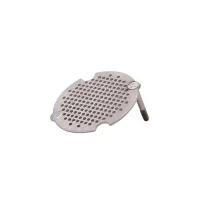


As a dedicated supplier of desalination plant titanium anodes, I've witnessed firsthand the critical role these anodes play in the desalination process. One of the key aspects that significantly impacts their performance is the thermal properties. In this blog, I'll delve into the thermal property requirements for desalination plant titanium anodes, sharing insights based on my experience in the industry.
Thermal Conductivity
Thermal conductivity is a fundamental thermal property that measures a material's ability to conduct heat. For desalination plant titanium anodes, an appropriate level of thermal conductivity is essential.
In desalination processes, such as reverse osmosis or electrodialysis, heat is often generated due to electrical resistance and chemical reactions. If the anode has poor thermal conductivity, heat can accumulate at the anode surface. This localized overheating can lead to several issues. Firstly, it can accelerate the degradation of the anode coating. The high temperature can cause the coating material to break down, reducing its effectiveness in promoting the desired electrochemical reactions. Secondly, overheating can also affect the stability of the electrolyte solution. It may cause changes in the solution's chemical composition, leading to the formation of unwanted by - products or scaling on the anode surface.
On the other hand, if the thermal conductivity is too high, it may lead to excessive heat dissipation. This can result in energy inefficiencies, as more energy is required to maintain the optimal operating temperature for the desalination process. Therefore, desalination plant titanium anodes need to have a balanced thermal conductivity. Titanium itself has a relatively moderate thermal conductivity, which can be further optimized through proper alloying and surface treatment.
Thermal Expansion
Thermal expansion refers to the tendency of a material to change its dimensions in response to temperature variations. In a desalination plant, the operating temperature can fluctuate during the start - up, shut - down, and normal operation phases.
If the titanium anode has a high coefficient of thermal expansion, it may experience significant dimensional changes when the temperature changes. These dimensional changes can cause mechanical stress within the anode structure. Over time, this stress can lead to cracking or delamination of the anode coating. The anode coating is crucial for its electrochemical performance, and any damage to it can severely reduce the anode's lifespan and efficiency.
Moreover, in a multi - electrode system, different thermal expansion rates between the anode and other components (such as the cathode or the supporting structure) can lead to misalignment or contact problems. This can disrupt the uniform distribution of the electric current, resulting in uneven electrochemical reactions and reduced desalination efficiency. Therefore, desalination plant titanium anodes should have a low coefficient of thermal expansion to ensure structural stability and long - term performance.
Thermal Stability
Thermal stability is another important thermal property requirement for desalination plant titanium anodes. The anode needs to maintain its chemical and physical properties within a wide range of operating temperatures.
During the desalination process, the anode is exposed to high - energy electrochemical reactions and harsh chemical environments. High temperatures can accelerate chemical reactions, including corrosion and oxidation. If the anode is not thermally stable, it may react with the electrolyte or other substances in the system, leading to the formation of corrosion products. These corrosion products can not only reduce the anode's performance but also contaminate the desalinated water.
For example, in some desalination processes that use chloride - containing electrolytes, high temperatures can promote the formation of titanium chlorides. These compounds are highly reactive and can cause pitting corrosion on the anode surface. To ensure thermal stability, the titanium anode may be coated with special materials that can resist corrosion and oxidation at high temperatures.
Impact of Thermal Properties on Anode Design
The thermal properties of desalination plant titanium anodes also have a significant impact on their design.
In terms of shape and size, the anode design needs to consider heat transfer. For example, an anode with a larger surface area can facilitate better heat dissipation, but it also needs to be designed in a way that ensures uniform current distribution. Complex shapes may be used to increase the surface area while maintaining a reasonable heat transfer rate.
The choice of materials for the anode coating is also influenced by thermal properties. Coatings with good thermal conductivity and stability can enhance the overall performance of the anode. For instance, some precious metal oxide coatings, such as iridium oxide or ruthenium oxide, are known for their excellent thermal stability and electrochemical activity. These coatings can be applied to the titanium substrate to improve the anode's performance under high - temperature conditions.
Related Products and Their Thermal Considerations
As a supplier, we also offer other related products such as the Titanium Electrolyzer for Water Treatment. Similar to desalination plant titanium anodes, the thermal properties of the titanium electrolyzer are crucial. In water treatment processes, the electrolyzer may generate heat during operation. A proper thermal design is required to ensure efficient heat dissipation and prevent overheating, which can damage the internal components and reduce the treatment efficiency.
The Titanium Anode for Fruit and Vegetable Machine also needs to meet certain thermal property requirements. Although the operating conditions in a fruit and vegetable machine are different from those in a desalination plant, heat can still be generated during the electrochemical cleaning or disinfection process. The anode should have good thermal stability to ensure long - term performance and prevent the formation of harmful by - products due to overheating.
In an EDI (Electrodeionization) System, the Titanium Anode In EDI System is exposed to high - voltage electrical fields and varying temperatures. The anode's thermal properties, such as thermal conductivity and expansion, need to be carefully considered to ensure stable operation and efficient ion separation.
Conclusion
In conclusion, the thermal properties of desalination plant titanium anodes, including thermal conductivity, thermal expansion, and thermal stability, are crucial for their performance, lifespan, and efficiency in the desalination process. A well - designed anode with appropriate thermal properties can ensure stable electrochemical reactions, prevent corrosion and scaling, and contribute to energy - efficient operation.
As a supplier, we are committed to providing high - quality desalination plant titanium anodes that meet these strict thermal property requirements. Our products are designed and manufactured using advanced technologies and high - quality materials to ensure optimal performance in various desalination applications.


If you are interested in our desalination plant titanium anodes or any of our related products, we invite you to contact us for further discussion and procurement negotiation. We look forward to working with you to meet your desalination needs.
References
- Jones, D. A. (2016). Principles and Prevention of Corrosion. Pearson.
- Bard, A. J., & Faulkner, L. R. (2001). Electrochemical Methods: Fundamentals and Applications. Wiley.
- Revie, R. W. (2011). Uhlig's Corrosion Handbook. Wiley.