





Hey there! As a supplier of Desalination Plant Titanium Anodes, I've had my fair share of conversations with folks in the industry, and one question that keeps popping up is, "What are the physical properties requirements for desalination plant titanium anodes?" Well, I'm here to break it down for you in plain English.
First off, let's talk about why titanium is such a big deal in desalination plants. Desalination is all about removing salt and other impurities from seawater or brackish water to make it suitable for drinking, irrigation, or industrial use. This process often involves electrochemical reactions, and that's where titanium anodes come in. Titanium is a great choice because it's highly resistant to corrosion, even in the harsh, salty environment of desalination plants.
1. Corrosion Resistance
One of the most crucial physical properties of desalination plant titanium anodes is corrosion resistance. The seawater used in desalination contains a high concentration of chloride ions, which can be extremely corrosive to many metals. Titanium, however, forms a passive oxide layer on its surface when exposed to oxygen. This oxide layer acts as a protective barrier, preventing the underlying metal from reacting with the corrosive environment.
For example, if you were to use a regular steel anode in a desalination plant, it would quickly rust and deteriorate. But a titanium anode can withstand the harsh conditions for a much longer time. This not only reduces the frequency of anode replacement but also ensures the stability and efficiency of the desalination process.


2. Electrical Conductivity
Another important property is electrical conductivity. In a desalination plant, the anode needs to conduct electricity effectively to drive the electrochemical reactions that remove salts from the water. Titanium has relatively good electrical conductivity, which allows for efficient transfer of electrons during the electrolysis process.
However, the electrical conductivity of titanium can be further enhanced by applying a coating. Many desalination plant titanium anodes are coated with precious metals or metal oxides, such as ruthenium oxide or iridium oxide. These coatings not only improve the electrical conductivity but also increase the anode's catalytic activity, making the desalination process more efficient.
3. Mechanical Strength
Desalination plants are large - scale industrial facilities, and the anodes need to be able to withstand mechanical stresses. Titanium has good mechanical strength, which means it can resist bending, breaking, or cracking during installation, operation, and maintenance.
The anodes are often installed in large arrays, and they may be subject to vibrations, water flow forces, and handling during replacement. A titanium anode with sufficient mechanical strength can maintain its shape and integrity under these conditions, ensuring reliable performance over its service life.
4. Surface Area
The surface area of the anode also plays a significant role in the desalination process. A larger surface area provides more sites for electrochemical reactions to occur. This means that more salt ions can be removed from the water in a given amount of time, increasing the overall efficiency of the desalination plant.
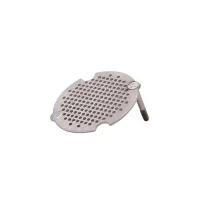
Manufacturers can design titanium anodes with different shapes and structures to increase their surface area. For example, Titanium Anode Mesh for Swimming Pool Disinfection often has a mesh - like structure, which not only increases the surface area but also allows for better water flow through the anode.
5. Dimensional Stability
Dimensional stability is essential for desalination plant titanium anodes. During the electrolysis process, the anode may be exposed to high temperatures and chemical reactions, which can cause it to expand or contract. If the anode changes its dimensions significantly, it can affect the spacing between the anode and the cathode, leading to uneven current distribution and reduced efficiency.
Titanium has good dimensional stability, which means it maintains its shape and size under normal operating conditions. This ensures that the anode can work effectively and consistently over a long period.
6. Compatibility with Coating
As mentioned earlier, many titanium anodes are coated to improve their performance. The anode material must be compatible with the coating material to ensure a strong and durable bond. If the coating doesn't adhere well to the titanium surface, it can peel off during operation, reducing the anode's effectiveness.
Manufacturers need to carefully select the coating material and the coating process to ensure good compatibility. For example, the surface of the titanium anode may need to be pre - treated to enhance the adhesion of the coating.
7. Uniformity of Properties
Uniformity of physical properties is also important. All parts of the anode should have consistent corrosion resistance, electrical conductivity, and mechanical strength. This ensures that the anode works evenly across its entire surface, preventing localized corrosion or under - performance.
During the manufacturing process, strict quality control measures are needed to ensure the uniformity of the anode's properties. This includes proper alloying, heat treatment, and coating application.
Now, if you're in the market for desalination plant titanium anodes, you might be interested in some of our other products as well. We also offer Titanium Anode In EDI System, which is great for electrodeionization processes, and Titanium Anode Basket for Water Treatment, which is useful for various water treatment applications.
If you're looking for high - quality desalination plant titanium anodes that meet all these physical property requirements, we're here to help. We've got the expertise and the manufacturing capabilities to provide you with the best products for your desalination needs. Whether you're building a new desalination plant or upgrading an existing one, we can work with you to find the right solution. Just reach out to us, and let's start a conversation about how we can meet your specific requirements.
References
- Jones, D. A. (2016). Principles and Prevention of Corrosion. Routledge.
- Revie, R. W. (Ed.). (2011). Uhlig's Corrosion Handbook. John Wiley & Sons.
- Fontana, M. G., & Greene, N. D. (1978). Corrosion Engineering. McGraw - Hill.